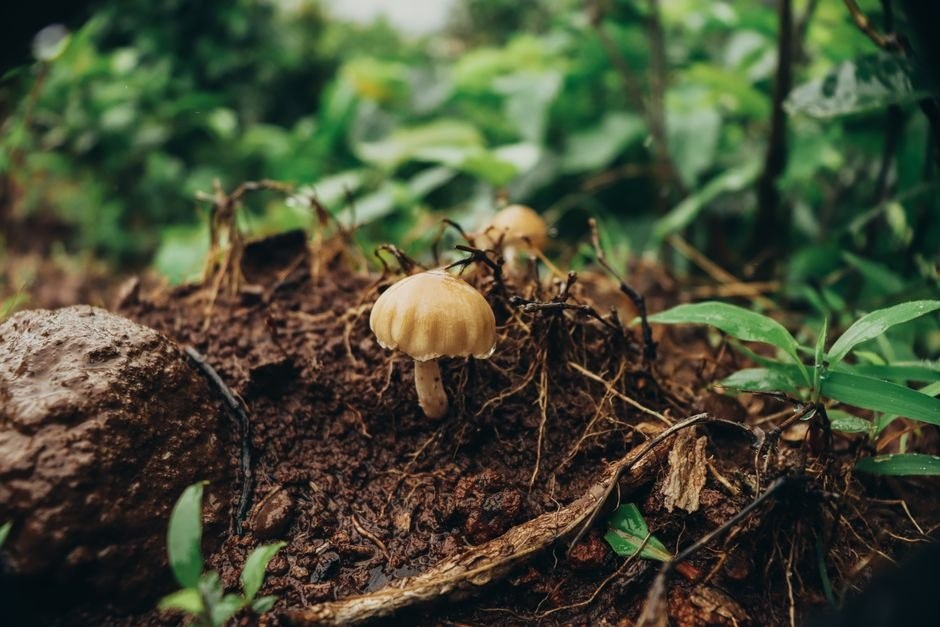
Rain changes the scale of a woodland walk. The broad view is still there—trunks, paths, leaves—but the interesting work moves closer to the ground. Fallen branches darken, moss brightens, and small mushrooms can appear in places that looked empty a few days earlier.
I like to go out the morning after a spell of damp weather with no plan beyond looking. The point is not to fill a basket. It is to see how much life becomes visible when the pace drops.
Begin where wood is already becoming soil
Old logs, broken stumps and leaf litter are good places to start. Fungi are part of the process that returns woody material to the forest floor, so decaying timber often holds far more variety than a clean stretch of path. I scan the shaded side of logs first, then the damp ground around their edges.
The first few minutes can feel unproductive. Your eyes are still tuned to larger objects. Then one small cap appears, and suddenly the forest seems full of them: pale buttons under leaves, orange shelves on bark, tiny stems rising from moss, delicate clusters in the crease of a fallen branch.
I do not pick unfamiliar mushrooms to identify them. Many species are difficult to distinguish, and photographs are enough for the kind of walk I want. If identification matters, I use several clear images and a reputable field guide later. Nothing found on a casual walk should be treated as edible on appearance alone.
Photograph the surroundings, not just the cap
A close photograph is useful, but context tells more of the story. I take one wider frame that shows whether the mushroom is growing from soil, living wood or a fallen branch. Then I move closer for the shape of the cap and stem. If the underside is visible without disturbing it, a side angle can show gills, pores or other structures.
The process makes me notice details that would otherwise pass quickly: the direction water has run along a log, the way moss holds moisture, or how a cluster is protected by a root. Even when I never learn the species name, I remember the place more clearly.
Move slowly enough for the second look
The best discoveries are often behind the first obvious one. After finding a mushroom, I stop and look a metre around it rather than immediately moving on. A second species may be tucked under the same log, or a much smaller cluster may sit in the background.
This habit changes the walk. Distance stops being the measure of whether the morning was worthwhile. A short loop can take an hour because every patch of ground has layers.
By the time I return to the main path, the forest feels more detailed than it did at the start. That is the real pleasure of looking for mushrooms: not the collection, and not even the names, but the reminder that a familiar place can become unfamiliar again when you choose a smaller field of view.